
People and Incentives: Designing Systems That Scale (Article 3/5)
Standing on the shoulders of Titans

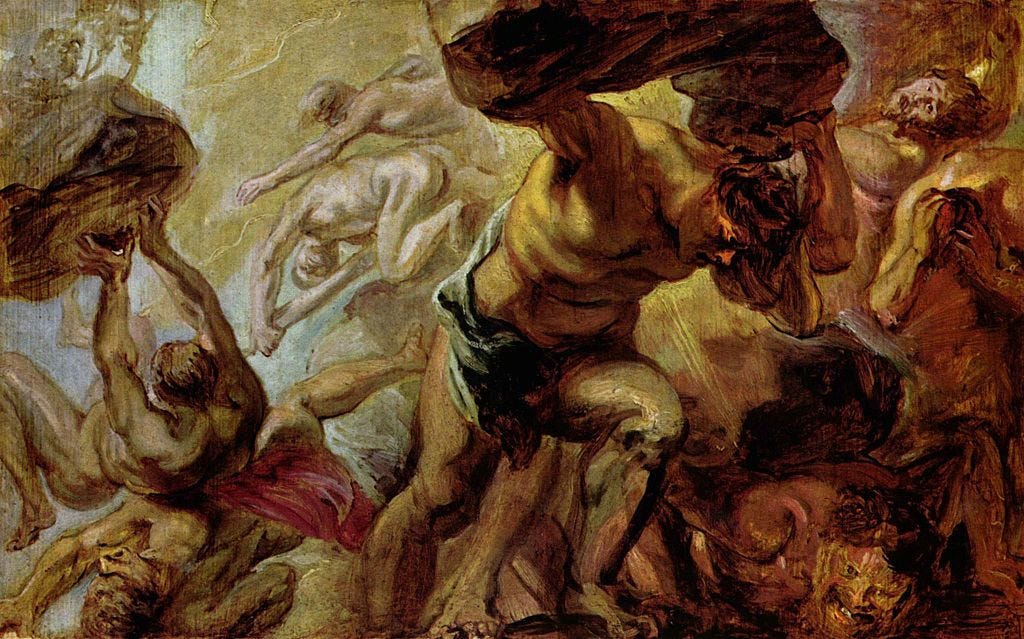
{Peter Paul Rubens, "Fall of the Titans," circa 1637-1638.}
“The culture precedes positive results. It doesn’t get tacked on as an afterthought.” - Bill Walsh
So far, since I began writing this series, “Standing on the Shoulders of Titans,” I have looked at two aspects of setting up a successful business.
My first article dealt with generating an idea. I looked at where and how some of the great business leaders developed their ideas.
The next article was the second in the series, and it focused on how titans of industry used discipline to manage and allocate their capital to maximum effect.
This article - the third in the series - will focus on individuals who understood how to scale their businesses, the main ingredient of which is people.
Yes, so many aspects are crucial, but the right people are what make things happen.
Attracting the right people requires a few crucial ingredients.
The right incentives must be in place.
People must feel like they are a part of something that they can be proud of.
The owners/manager must actually care about them.
The right culture is also another crucial ingredient; humans need to feel part of a community or a group with a shared goal or worldview, and any organisation can take on that role just as well as a community.
For the scope of this series, we are focusing exclusively on business leaders, but these similar principles exist across every group and organisation.
Now, we will look at examples of a few people who have done it best.
Jim Sinegal - Costco
Jim founded Costco in Seattle in 1983 with his business partner Jeffrey Brotman, based on the business model that he learned from his mentor, Sol Price. Jim had worked for Sol in FedMart, where he learned the tricks of the trade and worked his way up to an executive position.
Sol eventually sold FedMart but left soon after disputes with the new owner. He would go on to found Price Club. Costco would eventually merge with Price Club in 1993 to create the company we know today. Well, mostly….Price Enterprises spun off PriceSmart a year after the merger, and Sol and Robert Price left the new company to focus on their spinoff.
Jim Sinegal, much like his mentor, believed in running the company ethically. Costco would charge an annual subscription, and with that, the promise would be to offer the customer value they couldn’t receive anywhere else.
One way to ensure a happy customer was to also ensure happy employees, and that is what he strove for in his business.
Costco has consistently ranked among the best companies to work for in America. Their wages are among the highest in retail, and their attrition rate is among the lowest. Costco employees earn approximately $5-$10 more an hour than the employees of other retailers.
The company also offers fantastic benefits to its staff, from health insurance to retirement benefits, and this isn’t just for full-time staff; it is also offered to part-time staff, which is very rare in the industry.
Employees are also eligible for a bonus through the company’s stock, which incentivises employees in the long term.
In retail, the typical staff turnover rate is around 60-70% where as at Costco, it is 6-10%, meaning that although the company pays higher wages, it spends much less money on the acquisition and training of new staff as compared with its competitors.
Lessons
Treating employees with dignity and respect enables them to give their best in return and feel that they are being fairly compensated for the work they do.
As a result, there will be less staff turnover, fewer dissatisfied people working in the business and this will also appear in how they show up for and interact with the customers.
Les Schwab - Les Schwab Tire Centres
When it comes to incentives, few can do it as Les Schwab did.
Les grew up in poverty in a logging camp; his schooling in those early days took place in a railroad boxcar.
His mother, a teacher at the logging camp, passed away when Les was only 15 from pneumonia and his father, an alcoholic, was found dead a few months later outside a moonshine joint. He and his 3 siblings were orphaned.
Les began his career selling papers; he would be so successful that he was able to take on and manage multiple routes and people, all while attending high school. He would later become the circulation manager for the local paper. “The Bulletin” and served in the Air Corps in WW2.
It was at the age of 34 that Les took a gamble; he sold everything he owned, along with a little help from his brother-in-law, and bought an OK Rubber Tyre franchise in nearby Prineville, Oregon. He had never changed a tyre in his life.
Over the next few decades, he would transform that lone tyre shop into an empire.
How did he do it? - Incentives.
Les created an incentive structure that gave away half of the profits to the employees; those same employees would part-own and manage the stores as well as help train others to become future managers and assistant managers.
The company ethos was to promote from within, rather than hire outside management. It would prove to be a winning formula.
Les realised that it was better to share a large portion of a much bigger pie than to hold on to a much smaller pie all by himself.
Tyre Technicians who proved they were hard-working, honest, and willing to learn would have the opportunity to run a new store themselves when it opened. In each store, the profits would be shared between the company (Les) and the employees running the store. 50% of the profits were shared with the individual store, which was split among employees; the manager would receive the largest portion (maybe as much as 25%) and the assistant manager the second-largest.
The system encouraged the managers to run and develop the business; the more successful it became, the more they would be able to earn.
The assistant managers would use their time under their store manager to learn the ropes, and when the time came, and an opportunity presented itself, they would open their own store and assume managerial duties.
Over time, Les would perfect this incentive structure, and at the time of his death, there were 400 stores in 8 states.
Lessons
As the late, great, Charlie Munger said: “Show me the incentive and I’ll show you the outcome.” Les understood this intuitively.
Allowing the employees to share in the success of the business guaranteed they would put their best foot forward in the day-to-day operations. They would treat the business very different than someone who simply had a job; they felt like they had a form of ownership.
The company’s philosophy of hiring from within would help prop up that belief, as the best would rise to the top and would know the workings of the business better than any hire. This would help maintain the long-term success and growth of the business.
Mary Kay Ash - Mary Kay Cosmetics, Inc.
The story of Mary Kay Ash is one of perseverance and self-belief. At 45 years of age, she founded Mary Kay Cosmetics, about three weeks after the sudden death of her husband.
She had no choice; her money was invested, and the wheels were turning. To stop now would mean financial ruin.
With the help of her youngest son, she launched.
Mary Kay had spent years struggling. She divorced her first husband after WW2 and was effectively left to raise three young children, mostly on her own.
Working for Stanley Home Products, she was able to design a work schedule that fit around her children’s lives. For years, she was balancing a life of childcare, work and religion.
She would go on to become a top saleswoman, as well as build a network of additional salespeople for the company. She ended up receiving a promotion, which required that she move from Houston to Dallas, but in doing so, she would lose her additional income stream, as she had received a small commission from the sales of the network she had built. She had no choice but to take the role.
Mary would later move to World Gift Company and single-handedly build its direct sales department, and would be personally responsible for a 50% growth in the company’s turnover.
Then came the incident that changed everything.
A man whom she had trained was given a promotion; he would become her supervisor and receive twice the wage that she did. The company’s reason was that he was a man and needed more money as he had to support his family.
Never mind the fact that Mary Kay was a divorced mother of 3 children who had had to claw and scrape her own way to survive.
It was the final straw, and she resigned - or retired, as she called it.
Mary Kay had no pension or serious backup plan, so she decided to write a book. In it, she would detail her lessons, her beliefs about how staff should be treated and her ideas on how she felt a corporate structure and incentive system should be built.
She soon realised that what she was looking at was effectively a business plan and knew it was one that she should follow.
She decided that she would launch her own company, but first, she needed a product. Years earlier, Mark Kay came across a very effective homemade skin cream formula. The creator had died, but she tracked down his children, and they agreed to sell her the formula. It would cost her almost every penny she had.
She and her second husband, George, had decided to go into business together; she would handle the sales and marketing, and George would handle the administration. They set a date to begin trading, and 3 weeks before that, George dropped dead at the kitchen table due to a massive heart attack.
Again, life had decided to severely test Mary Kay Ash. Against all advice, she decided to launch the business anyway and convinced her youngest son to leave his well-paying job and join her. He agreed.
Her story was just beginning, and over the next few decades, she and her son Richard would develop the company into a powerhouse, but it wouldn’t be simple.
Mary Kay would build a company and use everything she learned about incentives and people to develop a top-class sales machine. Her system would involve recruiting and training saleswomen, who would be given the freedom to work the hours they wanted to accommodate their family lives. Saleswomen received commission on their sales; if they recruited other saleswomen, they would receive a commission on those sales as well. However, unlike the issues Mary Kay faced, she would not impose the same geographical restrictions as her previous employers.
Above all, Mary Kay believed in recognition, and she would ensure that her staff received it. The best operators would receive recognition, and their work would be rewarded. There was public recognition of people’s achievements, and the top saleswomen would be gifted with what would become the famous Pink Cadillac, the ultimate symbol of a top performer in the company.
Lessons
“Pretend that every single person you meet has a sign around his or her neck that says, ‘Make me feel important.’” - Mary Kay Ash
People want and need to feel appreciated for the work they do, they want to be rewarded fairly and be recognised for their achievements. Mary Kay knew this.
She also knew that the rewards had to be valuable; people weren’t going to go above and beyond for some silly plaque. They want and expect a cut of what they take in. She gave them that and more.
Isadore Sharp - Four Seasons Hotels and Resorts
“Issy” Sharp was born in Toronto, Canada, to Polish Jewish parents who emigrated from Poland in 1920. An eerie fact about where his father grew up was what the place would be known for in the decades to come - Max grew up in Oswiecim, which today is known as Auschwitz.
Isadore’s early career was as a builder and then a developer before he eventually moved on to what he would ultimately become known for, a hotelier.
His father was a builder, and he joined him after completing his education and graduating with a diploma in architectural technology.
Having begun with houses in a post-war Toronto, there was plenty of work to go around, and by the time Issy joined his father, they had moved on to apartment buildings.
Two things came together that really sparked the move into the hotel industry.
The first was when Issy’s friend hired him to build him a motel. He had sold his business and wanted to use the proceeds to build and run this motel. Issy didn’t think it would work, but it proved successful.
The second occurrence happened on his honeymoon. He and his wife, Rosalie, were staying in a very average motel, all they could afford at the time. In the middle of the night, to their surprise, they realised they were also sharing a bathroom with another room. Issy realised that if a place like that could make money, he could design and build something much better.
In 1961, he built his first Motel, effectively the first 4 Seasons, and for the next few decades, he would be heavily involved in the construction, financing and management of the hotels.
Over time, this view began to shift as the construction of each new hotel involved massive risk, exposure and a mammoth effort to get it operational. All this before the doors even opened to the public.
The Four Seasons group would begin to transition into management only. Issy realised it was a much leaner system that allowed them to focus on the quality of the service they offered without the pressure of financing, building and operating the premises too.
Over the next 20-25 years, he began to develop his four pillars on which the company would focus. These are: quality, service, culture, and brand.
Lessons
He created a culture of excellence. Implementing the golden rule, “treat others as you would like to be treated”. He believed in treating staff well and, by extension, expected them to treat the customers well. He wanted staff to go the extra mile for the customer, to ensure they enjoyed their stay.
When it came to quality, he decided that the group would only run medium-sized hotels, believing that they could be managed more effectively than larger hotels or resorts. He believed that in order to maintain their quality of service, this would be a better route to ensure that.
He hired (and fired) for attitude instead of skill. Skills can be taught, but attitude, not so much. They enforced the golden rule. He wanted to be able to encourage the right behaviours and scale them.
Conclusion
I believe that the power of incentives isn’t taken seriously enough. Owners or founders at the head of businesses usually have something pushing them to succeed; they want the recognition, they want the financial rewards, or they even have an innate need to build or create.
What I think many of them forget is that their employees may not have the same drives as they do. Most people want a level of security for themselves and their family, they want to be able to afford to have some leisure time and have enjoyable experiences, and they want to feel a sense of purpose or accomplishment in what they do.
The best builders of companies or organisations realise that and ensure that they build an incentive system to maximise it.
There are always incentives at play, good and bad. Incentivising positive behaviours is a much better route than doing noting as that inevitably incentivises bad behaviour.
“It is not from the benevolence of the butcher, the brewer, or the baker that we expect our dinner, but from their regard to their own interest.” - Adam Smith
Thank you for taking the time to read this article!
Did anything in this post make you think?
I’d love to hear from you in the comments!! 💬
If you liked this article or any of my work, you can click the link below.
This can be a one-time thing or an ongoing support!
Thanks in advance!