
Seeing an opportunity where others don’t.. (Article 1/5)
Standing on the shoulders of Titans

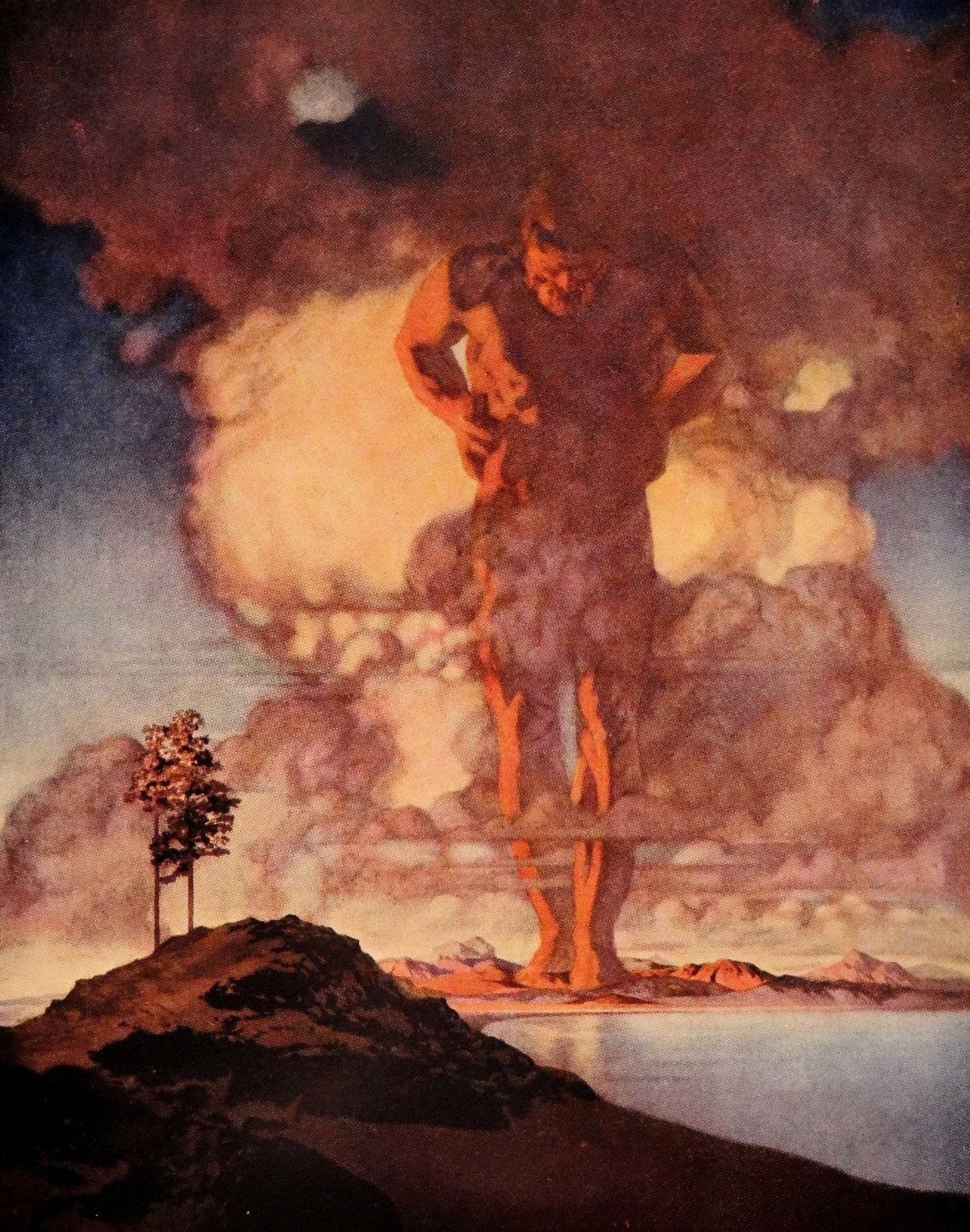
{Maxfield Parrish, 1910}
"If I have seen further, it is by standing on the shoulders of giants." - Isaac Newton
This is my first article in a 5-part series about standing on the shoulders of Titans. The theme that runs through each article is that we can look to the stories of others and take what they learned and use it in our own lives and work.
Each article will focus on a certain business theme, and I will then use several well-known business leaders as examples of that theme.
I feel that the best place to start is at the beginning. → The idea. The guiding principle on which a business is based. There is no business without it.
A business, at its simplest form, is offering something that makes life easier for someone else, and because of that, they are willing to pay for it.
Where then does the idea come from?
“Aha” moments are rarely that! It is usually much smaller, more of a sense or a feeling that begins to take shape. Not something that hits you smack on the face, even though on occasion it can be like a lightning bolt to the brain, but I think that is much more rare.
The process usually begins with awareness. Noticing how something is done and thinking there must be an easier way of doing it.
Or noticing a gap in the market and believing that you could fill it.
That is where the entrepreneurial wheels start turning. You realise there is a need and you believe you are capable of filling it and reaping the rewards.
But it all starts with an idea.
Phil Knight - Nike
In the opening chapter of his memoir, “Shoe Dog,” Phil recounts a memory. He is out for a run as a young man. In that piece, he describes the formation of an idea.
“Which led, as always, to my Crazy Idea. Maybe, I thought, just maybe, I need to take one more look at my Crazy Idea. Maybe my Crazy Idea just might… work? Maybe.
No, no, I thought, running faster, faster, running as if I were chasing someone and being chased all at the same time. It will work. By God I’ll make it work. No maybes about it.”
Phil had written a research paper about running shoes as a college assignment. Phil was an avid runner, and in that world, what you have on your feet matters. Running shoes need to be reliable and consistent. He needed comfortable running shoes, which offered support and allowed him to put in the miles.
As a self-proclaimed “business buff,” he knew that the Japanese had disrupted the camera market, which had been dominated by German brands, and had taken a large share of it.
He had a theory that the same could happen in the shoe market. The German brands of Adidas and Puma dominated the running shoe market, but Phil believed there was a space waiting to be filled.
While travelling around the world after finishing college, he made a stop in Japan. His goal was to follow up on his crazy idea.
He was aware of the “Tiger brand” running shoes manufactured by Onitsuka Co. (modern-day Asics), and he somehow managed to talk his way into a meeting with the company’s founder, Kihachiro Onitsuka. It was in this meeting that Phil made his pitch and convinced Onitsuka that his company (which did not yet exist) should be their distributor in the United States. Onitsuka agreed.
His “crazy Idea” was now in motion.
His company, “Blue Ribbon Sports,” would go on to make massive inroads for “Tiger Brand” in the U.S. market, with Phil’s cofounder and old running coach Bill Bowerman contributing to the design of their running shoes.
It would be a fruitful, if not fraught, relationship for seven years, and it would eventually sour. The writing was on the wall; so, Phil and his team would make a crucial pivot and begin designing and creating their own running shoes under the “Nike” brand. The company that we all know today.
It all began with a single idea.
Sam Walton - Walmart
I have already covered Sam in my “Titans Series,” so if you want a more detailed look at the founder of Wal-Mart, then give that a read. For this article, I am focusing more specifically on the ideas that led this small-town boy to become one of the world’s greatest retailers.
Sam was most definitely not what we would call an overnight success. He started his retail career working for JCPenney, and it became clear that Sam was a natural salesman and very good with customers. However, he wasn’t as proficient on the administrative side of the job, and because of this, a store auditor who worked for the company once famously commented:
“I’d fire you if you weren’t such a good salesman. Maybe you’re just not cut out for retail.”
Considering the passing of time and all that was to follow, that is up there with one of the most outrageously bad calls in all of business.
It can be seen as something of a beacon of hope. If Sam Walton could be considered that bad at one stage in his career, there should be hope for any of us.
Sam knew that retail was the right thing for him after his time in JCPenney’s. There was something about the industry that called to him and felt natural.
He and his wife, Helen, would eventually open a store in Newport, Arkansas, running a little variety store that was part of the Ben Franklin franchise. It was here that he learned how to become a retailer and some of the hardest and most important lessons of his career.
The “aha” moment didn’t come to Sam either; it happened more by accident. As he expanded his small retail enterprise, he realised that people living in small towns wanted more options and lower prices just as much as those in cities, and he knew he could provide them.
The larger retail outfits avoided the small towns, seeing them as a waste of time due to the much lower population density.
Sam picked up on something different. People in these small towns wanted choice and low prices just as much as people in the cities and would be willing to travel a greater distance in the name of value.
In fact, avoiding the large cities and focusing on the small towns allowed Walmart to make mistakes and learn from them for almost a decade before any of the bigger players took notice.
It wasn’t an “aha” moment either; it was an idea he stumbled on (mainly due to an ultimatum from his wife), but it would sow the seeds of an expansion that would allow Walmart to become the world’s largest retailer.
Ingvar Kamprad - IKEA
Ingvar began his career selling matches to his neighbours before moving on to other items such as fish, Christmas decorations and fountain pens.
To him, selling was a passion.
At 17 years of age in 1943, just before he went off to college, he officially started IKEA as a mail-order business selling mostly small household items.
The idea to sell furniture didn’t come to him until 1948, and it was most likely because his competitors were doing it.
Ingvar was effectively drop shipping long before the concept even existed. He would work with a supplier, advertise and sell the item via his catalogue and then the supplier would ship the item to the customer.
The so-called “aha” moments didn’t take place for Ingvar either; it was an accumulation of little decisions and ideas. Four ideas in particular birthed the modern concept when they came together.
First, he decided to create a catalogue of the goods he was selling. It wasn’t a new concept; it was being done in other parts of the world, but it was a very practical way of advertising his goods.
Second, came the addition of furniture. The very thing we know IKEA for today. Once he added that to his catalogue, it quickly became the main focus of the business. It made sense, furniture items were larger and higher-priced than his other products, so even thin margins still accounted for meaningful revenue on each sale.
Third, the idea of the showroom came as a result of the increasing competition in the market. The showroom was an opportunity for people to come, look and feel the furniture.
Fourth and the final piece of the puzzle came in the form of an idea that he didn’t invent either, but IKEA would be the first company to go all in on. This was the idea to flat-pack the furniture. Gillis Lundgren, an IKEA designer, suggested the idea to Ingvar after he had removed the legs of a table to fit it into his car. From there, it took off.
A few simple yet crucial ideas would morph into the world’s largest furniture retailer.
Reed Hastings - Netflix
Reed didn’t have an “aha” moment, per se. Still, as he tells the story, there was a single experience that made him aware of the inconvenience of the video rental system as it currently existed.
He encountered a large late fee after returning a video cassette 6 weeks late to a Blockbuster store. It brought to mind the inconvenience of the rental industry. It wasn’t the dawning of the idea, but it was an incident that played a part along the way.
It was while carpooling to work that Reed and his friend Marc Randolph started brainstorming business ideas, when the idea of mailing DVD’s was discussed and seen as a viable business. After a simple test, they decided it could work.
As it was the early days of the internet, the technology was still in its infancy, and Reed has stated in interviews that the long-term goal was always to create a business model that involved online streaming, hence the company name: Net Flix.
To get there, though, they needed to build a company that could survive and thrive in the rental market while the internet technology improved.
Initially, it was a of pay per rental system, the same as the existing model, but via online orders and postage to customers who, when finished, would post the DVD back to Netflix.
It wasn’t until a few years in that the subscription model was implemented, and late fees were done away with.
It was a much more convenient model for the customers, and it gave Netflix a stable and predictable income.
These two ideas paved the way. The first: removing the physical stores and operating over the internet, and the second: the implementation of the subscription model.
It would be these two ideas that would lay the foundation of what would become the world’s largest streaming company.
Conclusion
There are very few “aha” moments, but there are many in which an idea can begin to form. It doesn’t usually form all at once, but through trial and error.
What’s important is being on the lookout for how things are done. —> The good, the bad and the ugly.
It doesn’t have to be a revolutionary idea; in fact, it could be as simple as posting out a DVD or sending out a catalogue to potential customers.
What’s important is that we don’t ignore these thoughts when they come to us. Not every idea is great, but if we immediately dismiss it, we rob ourselves of the opportunity to think through it, to allow it to simmer.
If we have ten ideas in a year, one may be valuable. It may not be possible or practical, but the exercise of thinking through how it might work is a creative exercise that encourages out-of-the-box thinking.
What tends to happen over time is that your subconscious starts to look out for these opportunities without you even knowing it. You habitually think through the pros and cons. Eventually, something appears that is too good to ignore, and you take a chance.
You then embark on a whole new journey.
Thank you for taking the time to read this article!
Did anything in this post make you think?
I’d love to hear from you in the comments!! 💬
If you liked this article or any of my work, you can click the link below.
This can be a one-time thing or an ongoing support!
Thanks in advance!