

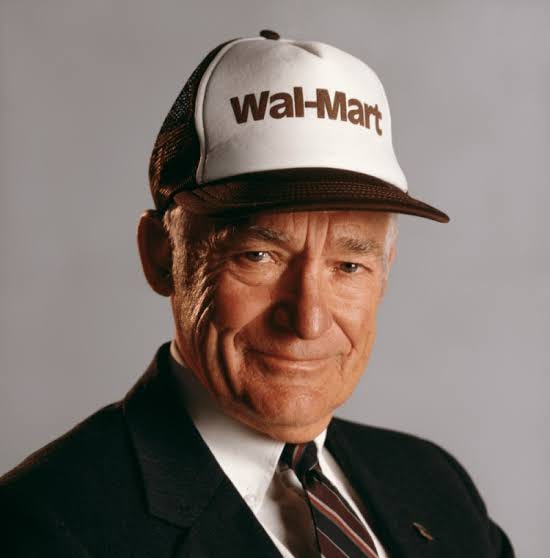
The assumption is that it takes uncommon individuals to accomplish uncommon things in the world! Sam Walton turned that notion on its head during his lifetime.
Sam was a common man, yet he managed to do uncommon things throughout his career and become the greatest retailer in the world.
In this article, I will go through some of the best lessons that I took from his autobiography: Sam Walton: Made In America
“If everybody else is doing it one way, there’s a good chance you can find your niche by going exactly the opposite direction.” - Sam Walton
Introduction
Sam was born in 1918 in Kingfisher, Oklahoma, the oldest of two boys - he and his younger brother, Bud, would work alongside each other for most of their lives.
He lived there until he was about five, but it was after the family moved to Springfield, Missouri, that Sam started school.
Like many people born in the USA around this time, the Great Depression and WW2 would have a profound impact on their lives and the lives of their families.
Sam would take on multiple odd jobs while attending school to help the family make ends meet. His mother had started a small milk business, and Sam would arise early, milk the cows, and his mother would bottle the milk. Sam would then deliver it after football practice in the afternoon.
Like many of the greatest entrepreneurs of the 20th century, Sam had a paper route as a young man and also found the time to sell magazine subscriptions.
He would spend his youth excelling at anything he tried. He would become the youngest Eagle Scout in the history of the state of Missouri at that time, save the life of a drowning friend, become student body president, and also be a successful American football player at both the high school and college levels. He even had a record of never playing in a losing football match.
To read all that, you would get the impression that Sam Walton was blessed with natural ability and skill, but he has disputed that, claiming he wasn’t gifted but very competitive and hard working.
After college, Sam went to work in the JCPenney store in Des Moines, Iowa. It was his first taste of retail and the beginning of a life spent in the sector.
In 1942, Sam was ready to do his part for the Allies in WW2, but due to a minor heart irregularity that came to light during the physical, he was classified for limited duty. Probably the first real time that Sam’s way forward was truly impeded.
In a state of low energy, he decided to quit his job at JCPenney’s and move to Tulsa, Oklahoma, as he awaited being called up for service. He had intentions of seeing what the oil business would involve, but ended up working at a DuPont gunpowder plant in the town of Pryor, outside Tulsa.
This change of course would be the best decision made by Sam Walton, as it would be where he met the woman he would marry, have four children and spend his life with: Helen Robson.
Sam would play his part during the war when he was called up for active duty, but due to his heart irregularity, he couldn’t see combat. He would become a second lieutenant and would spend his time supervising security at aircraft plants and POW camps.
He married Helen in 1943, and after the war, they decided they wanted to settle down and raise their family. In doing so, they would end up in Newport, Arkansas, running a little variety store that was part of the Ben Franklin franchise. This would be the beginning of a life spent working for himself in the retail industry.
This isn’t a life story about Sam, simply a short backstory of his early years and into manhood, the years that would lay the foundation for a man who would come from nothing to create the greatest retail company in the world.
What follows are some of the lessons that I took from Sam’s autobiography, based on an almost 50 year retail career.
Believe In Yourself
“It never occurred to me that I might lose; to me, it was almost as if I had a right to win. Thinking like that often seems to turn into sort of a self-fulfilling prophecy.” - Sam Walton
Sam had an unusual sense of self-belief. It seemed to work in tandem with his competitive drive.
It is one of the most crucial ingredients needed to create or build something of value.
Sam characterised that attitude throughout his life and career. It was what led him on his initial step of setting up a retail empire, running his first Ben Franklin variety store.
He required the help of his father-in-law by way of a $20,000 loan (as well as $5,000 of his own money) to run that first store, which at the time was quite the risk, yet that didn’t deter Sam.
That Ben Franklin was the only store that Sam and Helen ran for the initial five years of their time in the retail business, and they managed to turn what was a struggling store into a very successful one.
Sam had set himself a goal of becoming the most profitable variety store in Arkansas within five years. He achieved that goal.
At the end of year one, they had a revenue of $105,000, which represented an increase from $72,000 the previous year under the previous owner. By the end of year five, the store’s revenue was over $250,000 with a profit of between $30,000 - $40,000.
Self-belief is infectious; others can sense it and, in turn, become more confident in you and your ability. They believe that you will do what you say you will. Sam’s father-in-law was more than willing to loan him the money to start his first store because he also believed in Sam.
Always Remain Curious
“Sam, of course, stopped to look at a store—he always stopped to look in stores wherever we went—anywhere in the world, it didn’t matter.” - Helen Walton
Sam was endlessly curious, experimenting with ideas, looking for something that would get more feet in through the door of his stores.
When not in his own stores, he would spend his time researching his competitors.
H could be found jotting things down in his notebook (he would eventually replace this with a tape recorder). He was open to learning, he wanted to see what others were doing, what was working and what wasn’t.
Even family holidays weren’t sacred. Once, while holidaying in Italy, their car was broken into after Sam dragged them into a local retailer to have a look around.
This would be a trait that he carried throughout his lifetime. In one particularly famous story, Sam was arrested in Brazil by the local police as he was found measuring the space between aisles in one of the local retailers. They weren’t sure what this suspicious American was doing.
Curiosity is crucial for anyone who wants to learn and develop. No business can grow without it.
Care For Your Customers
“Everything we've done since we started Wal‑Mart has been devoted to this idea that the customer is our boss.” - Sam Walton
In the early days of what would come to be known as Walmart, especially after having gone down the route of discounting, the store’s priority was having the lowest prices. The quality of the merchandise or how they presented it may not have been as high a priority.
They would source whatever they could get and display it out front for as low a price as possible.
This idea of looking after the customer was to become their guiding principle, and it would allow Walmart time and space for its quality and managerial capacity to catch up.
As time went on, Sam began to recruit talent into the business, which in turn led to an increase in the quality of their stores, their merchandising, their buying principles and their management structures, which would later help them to expand across the country at a rapid pace.
He developed a simple philosophy in the early years of his retail career: he wanted it to be Walmart that customers thought of whenever they thought of low prices and high-quality customer service.
It is a simple idea yet a crucial one, a happy customer will be one who comes back again and again. Jeff Bezos used this same philosophy to fuel the growth of Amazon into the global goliath it is today.
The most crucial aspect of any business is having customers who buy from you and who return, again and again.
Share Your Success With Your Partners
“Speak to people coming down the sidewalk before they speak to you.” - Sam Walton
There is a common saying that people will forget what you said or what you did, but they won’t forget how you made them feel. Sam Walton, by all accounts, made people feel good.
He was viewed in a very positive light by those who worked with him, for him and even by those who competed against him.
Whether it was their admiration for his hard work or his friendly tone, there seemed to be a genuine warmth towards the Walmart founder.
“Our relationship with the associates is a partnership in the truest sense. It’s the only reason our company has been able to consistently outperform the competition—and even our own expectations.” - Sam Walton
A large part of the company’s success was due to Sam’s ability to hand over trust of the stores and then the departments within the company to capable people and allow them to do their job.
Sam gave his managers a lot of freedom to run their stores and room to try things, even running their own merchandising promotions which encouraged competition between store managers. Anything that worked could then be rolled out to the rest of the stores, so it was a win-win.
Humans in general want to feel valuable, to feel like they are adding something to their lives and the lives of others. Sam was comfortable in trusting his staff to take on a lot of responsibility. Whether it was Ferold Arend or Ron Mayer in the early days, or David Glass, Jack Shewmaker or Tom Coughlin as the company really started to generate speed and rapidly expand.
One truly great move they made was their profit-sharing system set up in 1971. This allowed the staff (associates as they would come to be known) to own a portion of the company.
Prior to this, any new store managers were brought in as limited partners for the store they ran, so they would own a small stake in the store. This would encourage them to work harder, to see their efforts as beneficial not just for the company but for themselves.
However, one major problem was that the general staff didn’t receive anything from this system.
Helen Walton first brought this fact to Sam’s attention, and although he may have been slightly defensive in the moment, he soon realised just how right she was. This single step was maybe the most important in the history of the company.
Not every business can go public, so it may not always be possible to take the same approach as Sam did. However, the principle is the same. Make your staff feel appreciated, give them responsibility within the business and show them that you take what they say seriously and make sure to incentivise and reward them for what they do, however that may look in your business.
Remain Humble
“Two things about Sam Walton distinguish him from almost everyone else I know. First, he gets up every day bound and determined to improve something. Second, he is less afraid of being wrong than anyone I’ve ever known. And once he sees he’s wrong, he just shakes it off and heads in another direction.” - David Glass
There are countless stories about Sam Walton spending his time wandering around competitors’ stores in order to take some form of lesson from the experience.
It didn’t matter to him if they were a large retailer or a smaller business of just a couple of stores; he knew there was always an opportunity to learn something.
In life and in business, it is those people who aren’t afraid to be wrong that will ask questions and learn that bit faster than those who aren’t willing to ask. Those who are afraid to look silly refrain from asking questions, so they continue to live in ignorance.
It wasn’t just an approach he took in how he handled his business, but a way in which he lived his life. Sam drove around in an old pickup truck with cages in the back for his bird dogs, even when he was worth multiple billions of dollars.
To Sam and his family, it wasn’t about the money so much as doing something that meant something to them. Building a company that could stand the test of time, that would bring value to their family, their customers and the wider community.
In order to learn from our mistakes, we must first be willing to acknowledge that we make them. Sam had no issue in doing this; his ability to hand off responsibility to others in areas they were better suited to run ensured the right people ended up in the right positions within the business.
It wasn’t all simple, though; they had to take risks and prove the viability of their ideas to Sam many times before they had the opportunity to move ahead with them. This ensured that ideas were well thought out before they were ever implemented.
Being humble isn’t a tactic; it is a way of being, a way of life. It encourages a culture of hard work and honest effort. It also encourages the behaviour in others and leads to better organisations.
Learn From Your Mistakes
“My naïveté about contracts and such would later come back to haunt me in a big way.” - Sam Walton
In my previous article (read it here), I used Sam as an example of how a problem can become an opportunity if you are willing to look at it from a different perspective.
Sam learned from his mistakes and then could move on to the next situation without a loss of enthusiasm or purpose.
David Glass, who would eventually become the CEO of Walmart, remembers the first time he was introduced to Sam Walton. It was an early store opening, and he had heard about Sam and went to check it out. To say it was a disaster is an understatement. To cut straight to the point, it consisted of burst watermelons mixed with donkey droppings in scorching hot weather that all combined to create a chaotic cocktail.
The interesting thing is, anyone who met Sam in those early days liked him, but none really foresaw just how much he could learn, how he could adapt and prosper as a result.
Sam was no doubt an intelligent man, but I think his ability to learn from mistakes may have been his most important quality. Not just his own, but by studying what others did well, he was able to leverage the lessons that they may have learned the hard way, too.
It is for this purpose that we read books and Substack articles related to people like Sam. He asked questions, saw what worked for others and what didn’t work, then implemented what worked.
The goal of this newsletter is the same: find good ideas or principles and take action on them, or avoid those things that need to be avoided.
Charlie Munger may have said it best:
“It is remarkable how much long-term advantage people like us have gotten by trying to be consistently not stupid, instead of trying to be very intelligent.”
Control Your Expenses
“You can make a lot of mistakes and still recover if you run an efficient operation. Or you can be brilliant and still go out of business if you're too inefficient.” - Sam Walton
One lesson that consistently emerges time after time in the history of successful business founders or managers is their understanding that expenses have to be controlled as a principle.
I’ve even seen this experience first-hand with my father in a family business.
Mistakes are going to happen, costs are going to increase, and things will not pan out as expected. These are all things that are out of your control, and it is in these moments that a business which has stretched itself too much will stumble and maybe fall.
There have been few expectations of this rule; in order to ensure the survival and growth of a business, there must be a culture of controlling expenses.
In the early days of a company, waste will sink a company before it even gets off the ground and larger, more successful companies regularly collapse if expenses haven’t been managed and bloat starts to develop. When the time comes for decisive action, the business isn’t able to move fast enough and likely fails as a result.
Sam and his brother Bud both grew up in the depression, and it engendered a belief that every penny should be made to count.
Sam and his early Walmart team would travel to New York on buying trips to gather valuable merchandise. He wanted to ensure they were there for as short a period as possible and, in that time, would get as much value as possible.
He would organise to meet buyers very early in the morning and continue until very late at night; most of the time, it would involve finding people willing to arrive early and stay late to keep their warehouses open.
The next morning, they would be up for breakfast at 6 a.m., even though it would be hours until anywhere opened. He would insist that they walk everywhere to save on transport, and of course, they would have to share their rooms.
Being conscious of the money a company spends is not just a way of thinking or acting; it is a culture that permeates a company. It becomes the standard operating procedure.
As the Scottish-American industrialist Andrew Carnegie said:
“Watch the costs, and the profits will take care of themselves.”
Swim Against The Tide
“Sam, we’ve been married two years and we’ve moved sixteen times. Now, I’ll go with you any place you want so long as you don’t ask me to live in a big city. Ten thousand people is enough for me.” - Helen Walton
Great ideas aren’t always obvious, and they don’t always come from a spark of inspiration.
One of the ideas that would shape the development and growth potential of Walmart into the future didn’t appear as an obvious idea at all; it came as a result of an ultimatum.
Helen Walton let Sam know, very early in their marriage, that she had no interest in living and raising a family in a big city. This led them to Newport, Arkansas, where they opened their first variety store, and it would be in towns of a similar size in which their retail empire would be built.
They would discover, as time went on, that these towns that were ignored by the larger retail chains were crying out for a variety of options and prices they could afford and that people would be willing to come from miles away to shop if the store offered this.
If they had been the offshoot of a corporation, then they may have never located in the small towns when, in fact, it was these towns that gave them the room to grow and expand, mostly unnoticed in the early days. By the time any of the larger retailers started to take notice, they had developed so much momentum that they couldn’t be stopped.
Having to be creative out of necessity is what helped drive the growth of the company in those early days. Sam and his team liked to try things out, to experiment, and this led to some of the greatest innovations within the industry.
An early example of this happened in his Bentonville store. Sam adopted the self-service layout (it was only the third of its kind in the whole country), which today is the standard layout of all retailers.
It was also this way of thinking that led Sam to open his first “family centre” under the Ben Franklin franchise, which taught him that people would come to larger stores to shop and that these stores could be very financially successful.
It was not simply one out-of-the-box idea that turned Walmart into the behemoth it is today, but a culture of thinking like this. Looking to others for inspiration, experimenting, asking questions and trusting associates to offer up their ideas and implement them over the stores too.
There is truth in the idea that if you do what others do, you will get the results that others get. It is in swimming upstream, against the current, where the real groundbreaking opportunities arise.
Final Thoughts
The book was jam-packed with lessons and ideas, and in truth, I could write multiple articles delving into them, so I‘ve no doubt I will revisit Sam Walton on many more occasions.
One of the main lessons that I took from the book but didn’t write about above was Sam’s ability to initially move slowly, before moving with speed.
In his case, he focused on a single store (5 years in his first store) until he thoroughly knew the business, knew how to make that store a success and how to maximise its potential, then when the time came, he started scaling the business at a faster and faster pace after he learned more about the business and industry and how to expand within it.
Great business icons such as Sam create ripples that expand out and end up having a much larger effect than they or anyone else could ever expect. Jeff Bezos would famously carry a copy of Sam’s autobiography around in the early days of Amazon and refer to it for inspiration. A lot of his ideas came from those he learned indirectly from Sam.
I will leave you with a final quote from Sam:
“There’s absolutely no limit to what plain, ordinary, working people can accomplish if they’re given the opportunity and encouragement to do their best.”
What about this post made you think?
I’d love to hear from you in the comments!! 💬
This was a great read thank you ♥️♥️♥️