
Cost and Capital: The Discipline That Built Empires (Article 2/5)
Standing on the shoulders of Titans.

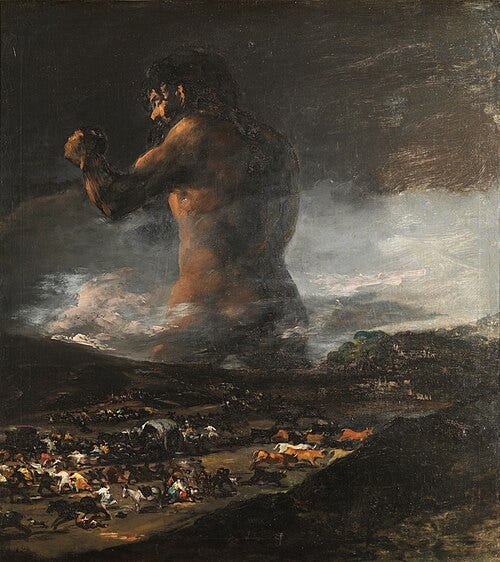
{The Colossus (El Coloso),Francisco de Goya, c. 1808–1812}
"Watch the costs, and the profits will take care of themselves." - Andrew Carnegie
In my last article, we discussed the idea, the first step in building or creating anything.
Nothing can come of nothing; we must have a thought or a goal. Some means we are working towards.
Once we know just what that is, we can begin to move towards it.
No business can succeed without capital, and capital needs to be managed correctly.
There is a saying in business: “Revenue is vanity, profit is sanity, but cash is king.”
There are many examples of individuals and businesses with great products or services that were unable to take a disciplined approach to capital and ultimately failed.
One such example was William C. Durant, the founder of General Motors, who had a talent for deal-making and sales. A genius at putting things together and making money, but he constantly took gambles that stretched him too thin. His lack of discipline led to his removal from the company he founded. He would live the latter years of his life modestly after his financial ruin.
The great operators of the business world always have an eye on the finances. They are disciplined when it comes to expenditure, but they also know the value of well-placed capital and are not afraid to invest in better ways of doing things.
The following examples are men who epitomise financial discipline and knew how to truly put their capital to its best possible use.
John D. Rockefeller - Standard Oil
The name Rockefeller is synonymous with money and power. It all stems back to the founder, John D.
Rockefeller was a devout Baptist and had a simple guiding principle: He would become as wealthy as possible, and he would use that wealth to help others.
It may seem disingenuous, but by all accounts, he did believe this.
By the time he was first introduced to the oil industry, he was a bookkeeper and partner in a produce commission merchant firm. It was his business partner’s friend, Samuel Andrews, who would become their business partner in the oil industry.
As the huge potential of the oil industry became evident to him, he decided to go all in. The industry would not develop if the current boom-and-bust cycle continued to play out, as every discovery would force the price down. Rockefeller knew that the product must be standardised and the supply better controlled. With this idea in mind, he co-founded Standard Oil of Ohio.
Rockefeller focused first and foremost on the refining side of the business. It was the choke point of the industry; crude oil needed to be refined to become a viable product.
One of his key realisations was that there were economies of scale to be had. The larger and more efficient his factories, the better and cheaper he would be able to refine oil.
He began to horizontally integrate as he systematically consolidated that side of the industry through mergers and acquisitions. As he scaled, he was able to create greater efficiency in his business, allowing him to refine oil at a lower and lower cost.
Soon, he was able to make a profit at a price that his less efficient competitors could not, and he started pushing his advantage, engaging in price wars with competitors to either force them to sell to him or drive them out of business, at which time, he could pick up the pieces.
This allowed him to stabilise prices and margins in the industry, and Standard Oil soon began to vertically integrate as he started moving into other aspects on which the business depended, such as storage, transport, and distribution.
Standard Oil became known as “the Octopus” as its power and influence stretched out across all aspects of the oil industry and related industries like tentacles, and there was no business that could compete with it. It would take the U.S. Federal government stepping in to finally do that.
Lessons
Horizontal & Vertical Integration allows a business to have more control over its costs and reduce its overheads, which in turn can be used to reduce the cost per unit of what it supplies.
Standard Oil did this better than anyone at the time; they could make profits at prices where no other could, eliminating their competition.
Andrew Carnegie - Carnegie Steel
Carnegie worked many jobs from the ages of 12 to his mid-thirties: Bobbin Boy, Boiler Tender, Office Clerk, Telegraph Messenger, Telegraph Operator, Railroad Assistant, Railroad Superintendent, and War Superintendent for a period during the Civil War.
He was a sponge for information and had no problem with taking on responsibility. His interest in learning was no secret; he would spend many of the hours that he wasn’t either working or sleeping with a book in his hands.
Yet, even though he ended up being very well paid, he was earning a wage at his job. If he stopped working, so too did the wage.
A defining moment in his life was how he felt after opening his first dividend check. He would have a very different way of looking at money from that day on, and making it work when he wasn’t.
It was while working as the personal secretary and telegrapher to Thomas A. Scott (Pennsylvania Railroad) at the age of 20 that Scott offered Andrew the chance to invest $500 in ten shares of the Adams Express Company. He agreed, but the reality was that he didn’t have that kind of money; it was 75% his annual wage.
Yet, his mother trusted in her son implicitly and mortgaged the family home to get it. At that, Andrew Carnegie became a business owner.
That dividend check was the first time that he received money simply for owning capital and not having to do any extra work. It was a life-changing realisation.
Over the next decade, he would invest in many more companies and develop a portfolio of businesses that would pay him much more than his annual salary, and he would eventually leave the Pennsylvania Railroad Company to focus on his investments and live a more leisure-oriented life.
Carnegie was involved in Iron through his Keystone Bridge Company, but on a trip to England in 1872, he visited the steelworks of Sir Henry Bessemer. After seeing his process for refining steel (the Bessemer process), Andrew realised the days of iron were over, and steel was going to become the building block of the next century.
After he returned to America and soon began work on his own massive steel plant. He soon realised that he needed to focus all of his attention on this industry, selling his shares in all other interests and focusing solely on what would become Carnegie Steel.
He famously wrote in his autobiography:
“Put all your eggs in one basket, and then watch that basket.”
He would grow this to become the largest steel company in the world before selling to JP Morgan and a group of investors for $400 Million and becoming the richest man in the world for a time (Rockefeller passed him again after the breakup of Standard Oil).
Lessons
Capital, if used correctly, can work for us when we are not working. That is known as leverage. Owning shares in productive businesses or outright owning a business.
Carnegie also teaches us a second, crucial lesson. That is the importance of focus. He decided to remove all distractions and go all in on the business that he believed (and correctly so) had the most potential.
Henry Ford - Ford Motor Company
Henry Ford was voted the “Businessman of the Century” in 1999 by Fortune magazine, and it is a more than fitting title.
Although a deeply flawed man, it cannot be denied that his drive to reduce the price per unit of each car that he sold had a defining impact on the creation of the middle class in the US and Western Europe.
The U.S economy to this day is still very motor-reliant, and unlike the cities of Europe, which are very pedestrian-friendly, the U.S cities are very different, and the need for a car is very evident.
To understand Ford, you must understand his goal, or some might say mission.
It was to produce an affordable motor vehicle for the masses. He did not believe in creating a lavish plaything for the rich, but instead wanted everyone to have that opportunity and freedom to drive.
He did not achieve his goal on the first try. In fact, it would be his third company that saw success and truly benefited.
This would be the “Ford Motor Company”, in which Henry owned 25.5%, which he would later increase to 58.5%. This is where the true development of the company took place; it became a behemoth and came to dominate the market.
Henry’s ideas started to conflict with those of the other shareholders in the company (which also included the Dodge Brothers) as the company grew and became more successful. Ford believed that most of the business’s profits should be reinvested in the business, whereas his other shareholders believed they should receive more of the profits as dividends.
Things eventually came to a head when the Dodge Brothers brought him to court and won the case, and Ford was forced to pay out huge dividends to its shareholders.
The outcome of this appeared to wound Ford, and he did something no one expected: he retired and handed the reins of the presidency to his son, Edsel.
Rumours started to circulate about Ford starting a new company which would produce cars to compete with and even better than the Model T.
Shareholders of the Ford Motor Company became nervous, and the stock price started to drop as a result. The next move was genius, but wouldn’t be possible today.
Several outside agents started buying up shares from the nervous investors, but what they didn’t know was that they were secretly acting on behalf of Ford. It wasn’t until it was too late that this became evident.
Now, 100% of the Ford Motor Company was owned by Henry, his wife Clara, and his son Edsel. He no longer had any outside dissenters in the company and could move forward with his mission on his terms.
Lessons
Without full control of your business, you will have to answer to others, and if they have a different view of how the business should be run, it can be very difficult and will limit the success of the business or cause it to fail altogether.
It is, however, a double-edged sword. Ford ended up living in an echo chamber; he had no one to question his decisions or the direction of the company, and as a result, they didn’t move into other segments of the market as it grew. As a result, General Motors ended up taking market share from Ford and eventually passed them out as the market leader.
Henry Singleton - Teledyne
Until maybe a year or eighteen months ago, I had never heard of Henry Singleton.
However, once you hear about him and his story, you cannot believe you didn’t know about him. Two of history’s greatest investors, Warren Buffett and Charlie Munger, rate him as one, if not the best, capital allocators in history.
Each person on this list had different ways of running a business, but shared a belief in both financial discipline and the importance of investing capital where it could be most productive.
Henry was no different. His approach to building Teledyne began with acquisitions. He bought companies across several industries, but they shared clear traits: strong cash flow, capable managers, and attractive returns on capital.
Teledyne’s stock price mirrored a company that was very competently run. One of his earlier initiatives was leveraging that high stock price to make acquisitions without having to go into debt.
He followed this model for years. Buying companies that he felt added to the portfolio of Teledyne, regardless of how the market felt about it. He would buy 130 companies throughout the 1960s.
Each subsidiary was independently run, and there were strict standards of fiscal responsibility that they had to adhere to. Singleton believed in the importance of cash flow and return on capital.
Revenue growth was important, but only if it meant the other metrics were improving too.
Profits of each subsidiary would be fed back to the parent company, and Singleton would decide how best to allocate that capital for maximum return.
Henry was described as having a singular focus, and that was Teledyne. By the end of the 1960s, he realised things had changed. He could no longer find suitable value in the market through acquisitions; the companies that would have previously interested him were now too overpriced.
He decided to make a shift in his strategy. It was a decision that had many questioning him, but would turn out to be an incredible business move and one that many businesses would replicate years later.
Teledyne started purchasing its own stock, which Singleton believed had become undervalued. He realised that it was the best place to allocate the capital and even fired his whole acquisitions team as he correctly believed they would no longer be needed. He wouldn’t acquire another business.
Lessons
Singleton was not swayed easily by the opinions of others; he would make decisions because he felt they were the right ones to make. He trusted himself fully; it is a crucial trait in any business leader.
Every business has to decide where best to allocate its capital. For Teledyne, that was first through acquisitions and then through share buybacks. For Rockefeller, Carnegie, and Ford, it was likely on new factories, machinery and vertical integration.
Conclusion
Each of these founders had a few things in common, as well as bringing different skills to the table.
They were all incredibly disciplined about where capital was put. They did not suffer waste but were not afraid to invest in the newest technologies, which in turn would work to create more efficiency and, in time, make savings.
Each one of them also had a knack for finding very talented individuals to work alongside. They would hire the best people and then give them the freedom to run divisions or even whole companies.
They were not without flaws. Some more glaring than others.
Ford ended up operating in an echo chamber, and I’ll not get into his personal and political views, as it’s beyond the scope of this article.
Rockefeller and Carnegie benefited from tactics that are illegal today.
The point of this article and the whole series is that, even though we are operating in a different period of time, the principles that these people used are just as important today. That is why we read about them, so we can learn what we should and shouldn’t do.
To finish, I will leave you with some wise words from the late Charlie Munger:
“It’s remarkable how much long-term advantage people like us have gotten by trying to be consistently not stupid, instead of trying to be very intelligent. Invert, always invert… If you don’t learn from the mistakes of others, you can’t live long enough to make them all yourself.”
Thank you for taking the time to read this article!
Did anything in this post make you think?
I’d love to hear from you in the comments!! 💬
If you liked this article or any of my work, you can click the link below.
This can be a one-time thing or an ongoing support!
Thanks in advance!