

“Difficulties show what men are. Therefore when a difficulty falls upon you, remember that God, like a trainer of wrestlers, has matched you with a rough young man. Why? So that you may become an Olympic victor; but it is not accomplished without sweat.” - Epictetus, (Discourses I.24)
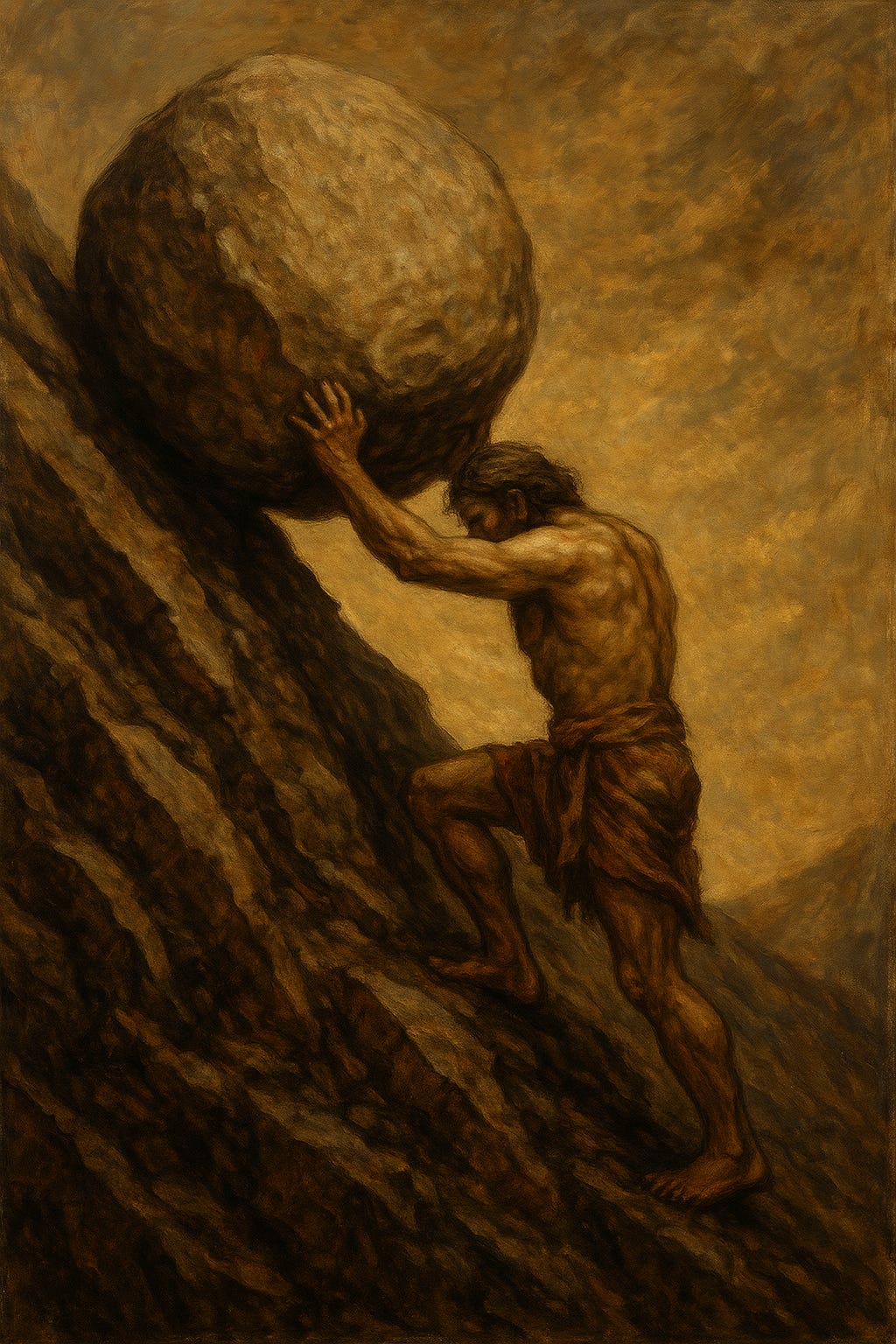
Most readers will be aware of the image of Sisyphus labouring to push the giant boulder up the mountain, but maybe fewer are aware of his name or his story.
In Greek mythology, Sisyphus was a King (likely of the city-state that would become Corinth). His kingdom would prosper and grow as a direct result of his cunning and guile.
It is this same cunning and guile that would lead to his ruin. He would eventually take things too far and invoke the anger of the Gods.
In the interest of his kingdom, he would pass on information about Zeus to another god; in return, his people would receive a spring of water, but it would cost him everything.
Zeus, as gods do, wanted his revenge. So, he sent Thanatos (Death) to claim the soul of Sisyphus. However, the crafty king outwitted even Death and, for a time, conquered it, not once but on two occasions.
Fate would eventually catch up with him, and as punishment, he would be condemned to spend eternity pushing a boulder up a mountain. Each time, just before he reached the top, the boulder would roll back down to the bottom, and he would be forced to start again. This cycle would continue endlessly.
And so, Sisyphus was doomed to relive this fate, day in and day out, coming close but never quite getting there.
Persist, No Matter the Obstacle
“I fully realised the value of tenacity. I just had to assume there was a way through any obstacle, and then I’d find it. This is perhaps my most fundamental principle of entrepreneurialism, and to success in general.” - Sam Zell
I am not so much interested in the crimes that brought him to the mountain but in what his labour symbolises. To me and maybe to others, today, that may differ from what the Greeks felt during Antiquity.
I believe that today, the image resonates with many as an example of the journey, the struggle in pursuit of a worthy goal or purpose.
A process of failure after failure on the road to the achievement of an ultimate goal.
What becomes evident to those who undertake that journey is that it isn’t as much about the destination but more about what is learned and who you become while getting there.
History and the present day are full of individuals from all backgrounds who have suffered and had to persevere. Both inspiring and cautionary tales.
Below are four such examples from history. Although they come from different backgrounds, they all faced immense resistance in their lives (of differing natures and intensity), all of which they would overcome.
Hetty Green was a famous financier of the late 1800s and early 1900s. A woman who would die the richest woman in America (and maybe in the world). The fact that she died four years before women would even have the right to vote makes her story even more impressive.
Hetty would grow up around wealth, taking an interest in finance from a young age and proving herself time and again to be incredibly capable.
However, no matter how capable she was, when her father died, his will was evidence that he hadn’t trusted her to manage the family’s wealth. Instead, the money was placed in a trust. Hetty would receive an annual income from that trust but had neither access to nor control over it.
A similar situation repeated itself after the death of her Aunt in the same year as her father.
She would spend her life fighting against prejudice in a world dominated by men in order to control her money and make her own decisions. She would become a colossus of stability and fiscal responsibility.
Hetty was so successful that she personally would come to the rescue of New York City on two occasions, loaning the city her own money until the panic subsided.
Estimates vary, but at the time of her death, it appears she was worth anywhere from $100 - $200 million, depending on the source, which today would be anywhere between $2-5 billion.
Ernest Shackleton was born in Kildare, Ireland, to a family of modest means.
He joined the merchant navy at 16 and would begin a lifetime of exploration.
He would take part in the Discovery Expedition to Antarctica from 1901-1903, the Nimrod Expedition from 1907–1909, after which he would receive a Knighthood.
But it was on the Imperial Trans-Antarctic Expedition from 1914–1917 that he would really make his name.
A failed mission would become one of the most inspiring stories of leadership, teamwork and survival ever told.
The book “Endurance: Shackleton’s Incredible Voyage” by Alfred Lansing gives a detailed description of the story. It is the account of how, after failure and disaster, Shackleton’s team were left stranded when their ship, “The Endurance”, was crushed by the ice.
It would be as a direct result of the leadership of Shackleton that every member of that team made it home alive after the most harrowing of experiences.
The following quote to me is the best description of the type of leader Shackleton was:
“For scientific discovery give me Scott; for speed and efficiency of travel give me Amundsen; but when disaster strikes and all hope is gone, get down on your knees and pray for Shackleton.”
Jackie Cochran’s (born Bessie Lee Pittman) background is uncertain. She claimed to have been adopted, but after her death, many sources disputed this.
What seems to be a fact is where she grew up and the environment in which she grew up. She was born in Florida and, by all accounts, was brought up surrounded by poverty.
She would grow up with an intense desire to become self-sufficient and wealthy, never again having to worry about going to bed cold or hungry.
Jackie would endure hardship many times throughout her life. She would marry very young and then lose her infant child while practically still a child herself. This led to divorce, but she would decide to hold on to her ex-husband’s name and reinvent herself by changing her first name to Jackie.
She would train to be a hairdresser in Pensacola, Florida and become successful in her career before moving to New York to take on a much more prestigious role in a salon on Fifth Avenue.
That would never be enough to satisfy her, and she would eventually go on to start and run her own successful cosmetics company under her own name.
It would be in aviation that she would make her name.
She wouldn't learn to fly until her mid twenties, but once she tasted them first moments of being airborne, it was clear she had found something that would become a part of her.
Within three weeks of deciding she wanted to become a pilot, she would pass her test and receive her licence.
Jackie would fly many exploits around the world, becoming a founding member of an all-women’s flying division in WW2, in which they would fly non-combat and domestic missions to allow more male pilots to be available for combat. It would eventually become known as the Women Airforce Service Pilots (WASP).
Jackie would break and hold countless flying records throughout her life and become the first female pilot to break the sound barrier.
Chung Ju Yung grew up in what would be seen today as abject poverty as he and his family struggled for survival, even going so far as eating tree bark during the winter months to survive in what is present-day North Korea.
He wanted more from life and ran away from home on three occasions in order to start a life for himself. His father would catch up with him on two of those occasions and take him home, but the third time was the charm.
Finally making his way to the city was what kick-started him along the path to building a business empire.
The beginning was humble; he began working in a rice shop. He would end up running, then owning that shop, before it was shut down by external forces. He would move on to start his own auto repair shop, followed by a construction company, ship building enterprise, automotive manufacturer and much more as the years went by.
He managed to do this in a country ravaged by not one but two wars (WW2 and the Korean War), all the while dealing with one authoritarian government after another. Yet, he kept moving, effectively starting from scratch on more than one occasion but doing so with the knowledge he had gained from his previous experience.
Chung would become the richest man in South Korea, creating the conglomerate, Hyundai
Conclusion
The commonality between the four individuals I have given above (other than the fact, all were alive at the same time for a short period: 1915-1916) was the fact that no matter the obstacle, they pushed through. When they were knocked back, they started pushing again. Never losing spirit or feeling sorry for themselves. They had a single goal: to win.
In mythology, Sisyphus never reaches his goal; he constantly falls short.
There are a few ways to look at that.
An excruciating experience where he constantly comes up short, never able to reach his destination, yet constantly getting within touching distance.
Or, maybe the task could become more than that, less about the outcome and more about the journey. As Albert Camus put it,
“The struggle itself towards the heights is enough to fill a man’s heart. One must imagine Sisyphus happy.”
It is a matter of perspective.
Who’s to say that his persistence will not one day take him to the summit? He will have achieved what he wanted. At that moment, he may even start to miss the struggle.
What about this post made you think?
I’d love to hear from you in the comments!! 💬