

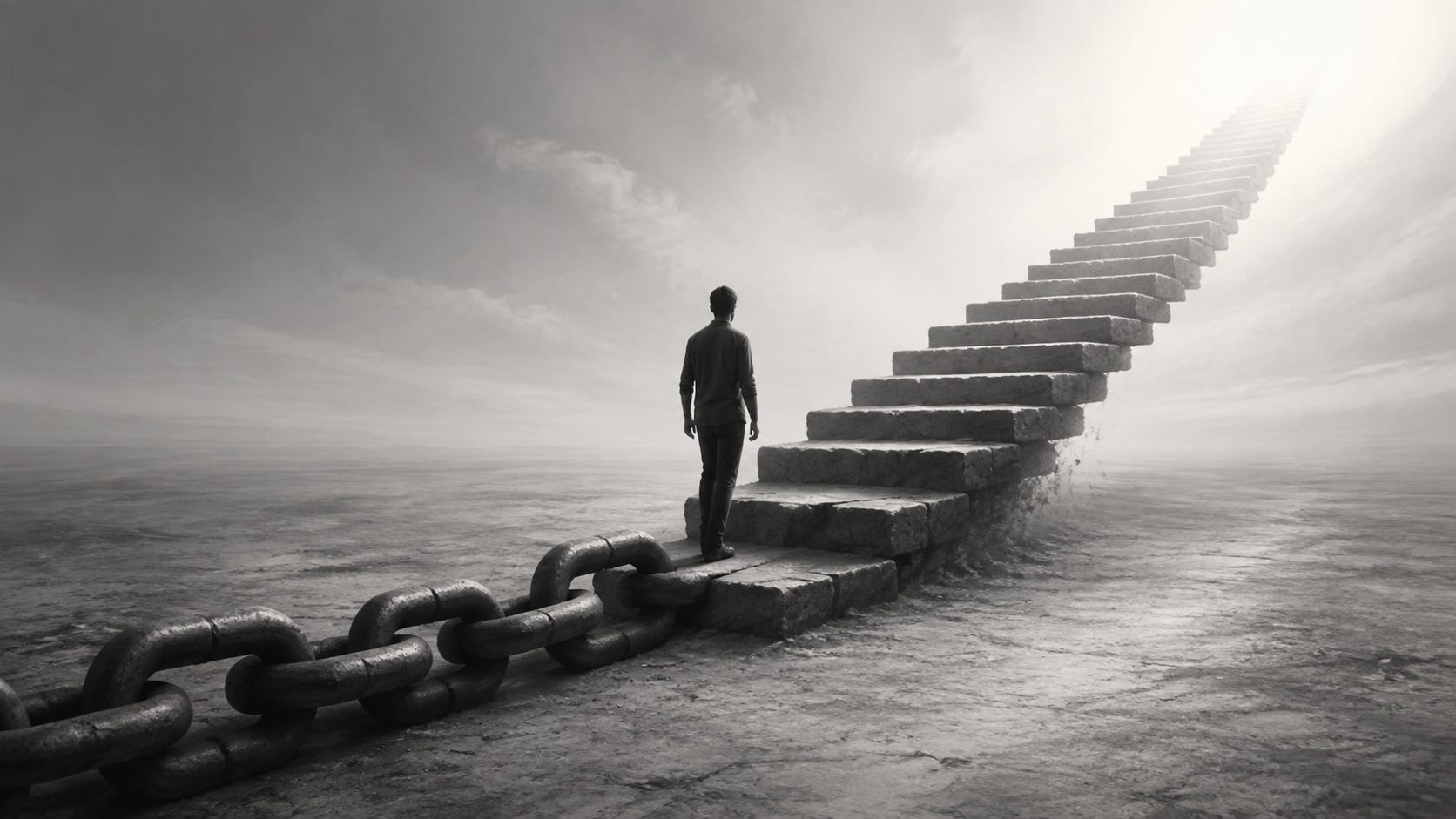
“We must attack the passions by brute force and not by logic; that the enemy’s line must be turned by a strong attack and not by pinpricks; for vices have to be crushed rather than picked at.” - Seneca
We all experience that universal frustration. It arises when we engage in something we know we shouldn’t instead of doing the things we know we should.
Doomscrolling.
Snacking.
Spending hours watching Netflix.
The passions come in many forms, creating an illusion of pleasure and satisfaction. That is, of course, what life is about, no?
That is the convenient story we tell ourselves, but the human mind does not work that way.
It is a falsehood, and most of us know it. A life spent in consumption does nothing for the mind, body or soul. It simply leaves us feeling empty.
It is an easy theory to test.
Spend a day engaged in all of the above. Scroll on your phone while lying on the sofa. Snack on the sweet or salty foods your body craves. Watch endless series or films on the streaming service of your choice. Stay up late and scroll some more in bed before going to sleep.
Spend the following day doing the opposite. Get out into nature for a walk. Do some form of intense exercise. Spend time doing focused work on a passion project. Eat healthy food. Read. Journal. Spend time meaningfully engaged with your other half, parents, children or friends. Then get a good night’s sleep.
After both days, take stock and ask yourself which one made you feel better. Not which one was easier, but which one left you feeling better.
How did you feel at the end of each day?
Our habits dictate our lives
The bestselling book Atomic Habits by James Clear examines some of the best tactics for dealing with negative or destructive habits.
Clear argues that willpower alone is not sufficient to eradicate poor habits. It can hold up for only so long because there will always be days when we are tired, stressed or short on time.
Habits are a crucial aspect of survival. Their purpose is efficiency. After we engage in a behaviour repeatedly, the brain begins to associate that behaviour with particular cues and outcomes. As that association strengthens, the behaviour becomes increasingly automatic, allowing us to carry it out more quickly and efficiently when we encounter the same trigger.
This capacity is an important product of evolution. It allows the brain to devote its limited attention to more important tasks rather than having to relearn each day how to get dressed, make breakfast or drive a car.
However, this system has some major flaws. One is that the brain does not automatically distinguish between a useful, productive habit and a negative, unproductive one. It learns from repetition and reward, not from whether the behaviour serves our long-term interests.
Once a habit has formed, it can be very difficult to break.
Hence smoking, overeating, scrolling and so on.
So, where does that leave us?
Habit is a double-edged sword. The same capacity to create habitual behaviour can be harnessed for good or ill.
It can make us slaves to our environment, our emotions and our cravings for quick dopamine fixes.
Alternatively, we can create an environment geared towards building strong and productive habits.
A vote for who we wish to become
“Every action you take is a vote for the type of person you wish to become.”
— James Clear
The more we engage in a positive behaviour, the more ingrained it becomes. Be careful, though: the inverse is also true.
Start by creating an environment that removes or minimises choice. Make doing the right thing easier.
Over time, it becomes the default position.
How well our environment is designed will help determine how successful we are at creating lasting, healthy habits.
If we have both an apple and a Mars bar within reach when we are tired and hungry, we are more likely to reach for the bar. If only the apple is available, we will reach for that. In time, it may become what we naturally want.
Identity
Over time, our behaviour begins to shape our identity and becomes part of how we see ourselves.
Clear calls these identity-based habits. You can read more about changing them directly from the man himself here.
These are habits we consciously build to craft a new identity for ourselves.
Identity is an incredibly powerful force.
It starts with deciding who you want to become and then proving it to yourself, time and again, through small wins.
The more consistently your actions align with the person you want to become, the more you begin to see yourself as that type of person.
If we start by reading one or two pages of a book every day, we may eventually read at every opportunity and come to see ourselves as readers. If we start by writing 100 words every day, we may eventually write 2,000 words a day and come to see ourselves as writers.
Brute force
The brute force of which Seneca speaks at the beginning of this article does not need to be anything drastic. It simply means making a conscious and decisive effort to eradicate negative habits and build positive ones.
One of the best ways to do that is by changing our identity. Instead of allowing our environment to decide who we are, we decide who we want to become and actively cultivate the habits that will lead us towards becoming that person.
“Men acquire a particular quality by constantly acting in a particular way.” - Aristotle
Thank you for taking the time to read this article!
Did anything in this post make you think?
I’d love to hear from you in the comments!! 💬
If you liked this article or any of my work, you can click the link below.
This can be a one-time thing or ongoing support!
Thanks in advance!